An exhibition of 24 illustrators and a book written by Elisa McCausland and Diego Salgado are part of the shared leitmotif
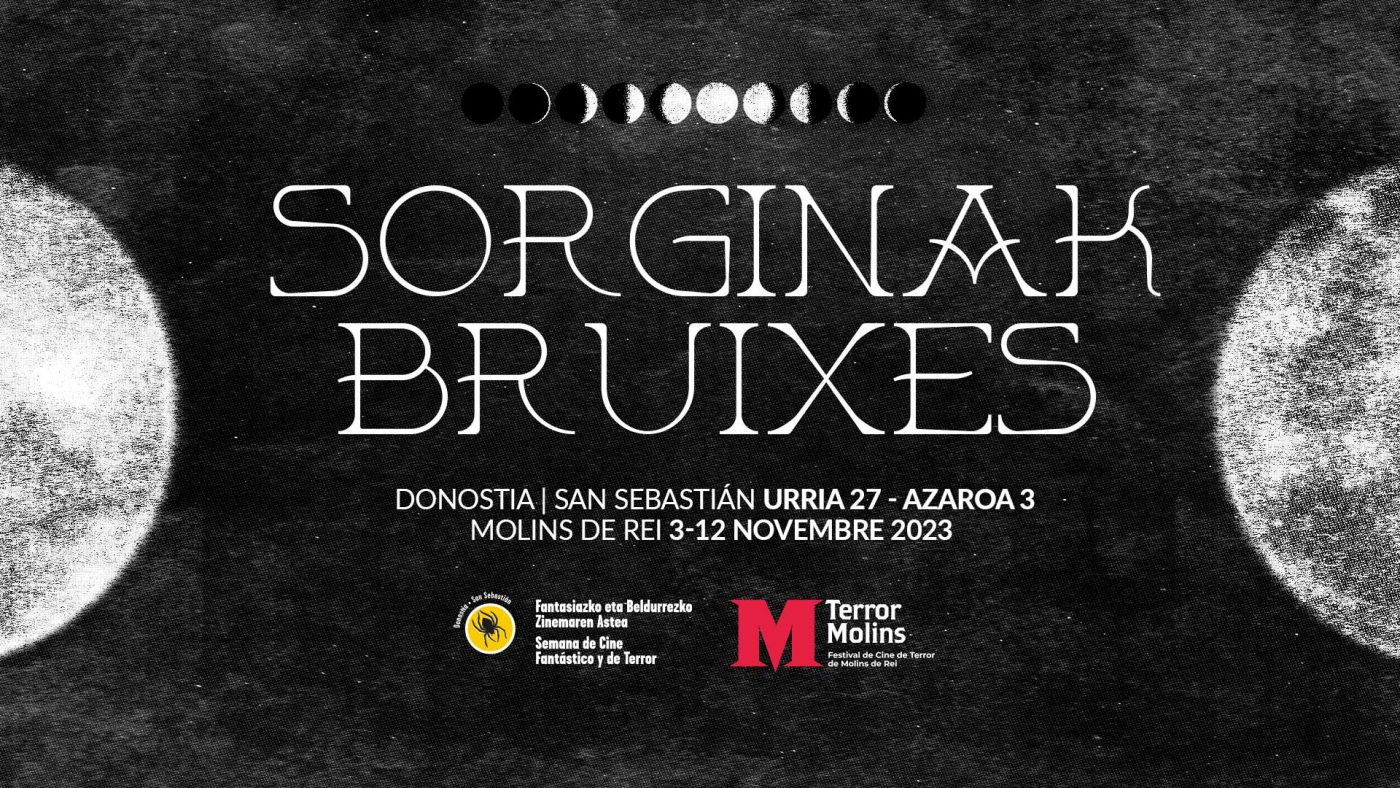
The Semana de Cine Fantástico y de Terror de Donostia / San Sebastián and TerrorMolins – Festival de Cine de Terror de Molins de Rei join forces this year to present joint activities focused on the world of witches, protagonists of the 2023 editions of both festivals, which will take place between October and November. The leitmotif is called “Sorginak-Bruixes”. i TerrorMolins – Molins de Rei Horror Film Festival join forces this year to present joint activities focused on the world of witches, protagonists of the 2023 editions of both festivals, which will take place between October and November. The leitmotif is called “Sorginak-Witches”.
The figure of the witch has been a source of inspiration for horror cinema since its origins, but it has acquired special relevance in the Basque and Catalan context, where cinema and literature have explored history, culture and identity under this prism.
The witch, in all her dimensions, is a character that continues to fascinate and terrify horror film audiences, but she has also experienced a redefinition in recent years, becoming a symbol of female empowerment and resistance to patriarchal and religious oppression.The Lords of Salem (2012), The Love Witch (2016), Akelarre (2020)–.
Basque witches are called sorgin or sorguiña, which could be “lucky maker” o “creator”. Catalan witches used the term witch, which comes from Latin witch o dirt (“biter” or “sucker”). Both have left a deep mark on popular culture, reflected in legends, places and festivals. In the Basque Country we find the Zugarramurdi cave or “Sorginen Leizea”, a location for witches’ gatherings. In Catalonia we find the Montsoriu Castle, Sant Feliu de Sasserra, or the Plaça de les Bruixes in Molins de Rei, where apparently the witches lived or met.
The Week of Fantastic and Horror Films and TerrorMolins gather this common cultural heritage and will celebrate it with an exhibition of illustrators and a shared official book, in addition to other activities to be announced later. The dates will be from October 27 to November 3 in Donostia, and from November 3 to 12 in Molins de Rei.
Exhibition
“"Witches - Sorginak - Witches. Illustrated room"”
Commissioner: Borja Crespo
The exhibition brings together 24 witches, with careers linked to comics, design and illustration, gathered to pay tribute to an essential representation in fiction, literary and audiovisual, that crosses our dreams and nightmares.
This ritual exhibition, curated by Borja Crespo, has a significant presence of’Basque authors (Ane Pikaza, Raquel Alzate, Higinia Garay, Josune Urrutia) i Catalan (Genie Espinosa, Sandra Uve, Susanna Martin, Nadia Hafid, Roberta Vázquez, Sara Bea, Sara Soler and Clara Soriano). We have called upon this selection of artists to pay tribute, with the magic of their talent, to the importance and appeal of a symbol that stars in fairy tales and is present in some horrifying passages of our history.
The exhibition can be visited during the two festivals. In Donostia it will be installed in the San Jerónimo Room (Activities Room of the Municipal Library) and in Molins de Rei in the Ca n'Ametller Exhibition Room.
Complete list of participating illustrators: Raquel Alzate, Sara Bea, Carla Berrocal, Natacha Bustos, Olga de Castro, Genie Espinosa, Mabel Esteban, Ana Galvañ, Higinia Garay, Nadia Hafid, Irene Márquez, Susanna Martín, Mermelada de Sesos, Ana Oncina, Laura Pérez, Mireia Pérez, Miriampersand, Ane Pikaza, Sara Soler, Clara Soriano, Josune Urrutia. Sandra Uve, Teresa Valero and Roberta Vázquez.
Official book
eso negro: Witchcraft, cinema and pop culture
Authors: Elisa McCausland and Diego Salgado
As every fan of the forbidden arts knows, the infamous osculum or kiss on the devil's anus, his other mouth, seals a human being's surrender to the spells of evil. Black kiss: Witchcraft, cinema and pop culture picks up this image from its title to evoke dark light on a phenomenon that has not ceased to manifest itself in one way or another in popular culture since the beginning of the Age of Reason: witchcraft.
After an introduction in which the impact of this on the cultural and artistic sphere of the last two centuries is reviewed as a manifestation of a buried discontent towards the values of Modernity, the essay goes on to contrast in two well-defined sections the characters of the wizard and the witch, omnipresent in audiovisual fiction. The wizard and the witch are complementary figures, but also antagonistic, if we pay attention to the means and ends they pursue when subverting dominant values.
Black kiss: Witchcraft, cinema and pop culture analyzes the strategies of both to transform reality through a journey that has its epicenter in cinema, but does not forget the small screen, comics and other visual and audiovisual expressions in which the wizard and the witch have struggled to materialize another way of being and being in the world. From Dion Fortune (1890-1946) and Häxan: Witchcraft through the ages (1922) until The witch (2015) and the necromancers of TikTok, a journey in which everything seems to have been said and in which everything is yet to be invoked.
The book will be published by Editorial Hermenaute.
About Elisa McCausland and Diego Salgado
Elisa McCausland, journalist, critic and researcher, and Diego Salgado, film critic and cultural communicator, have been reflecting for more than fifteen years on the meanings, contexts and potentials of popular culture and its manifestations, with special emphasis on cinema and comics. They currently share the microphone at Trenches of Pop Culture and they write criticism and studies about audiovisuals in specialized publications Directed By, Rockdelux, SoFilm i Solaris. They are promoters and collaborators of the ECC-UAH Chair in Comics Research and Culture and have written the essays Supernovas: A feminist history of audiovisual science fiction (errata naturae, 2019) and Dreams and fables: History of Vertigo (ECC, 2022). In addition, Elisa is the solo author of Wonder Woman: Feminism as a superpower (2019).