
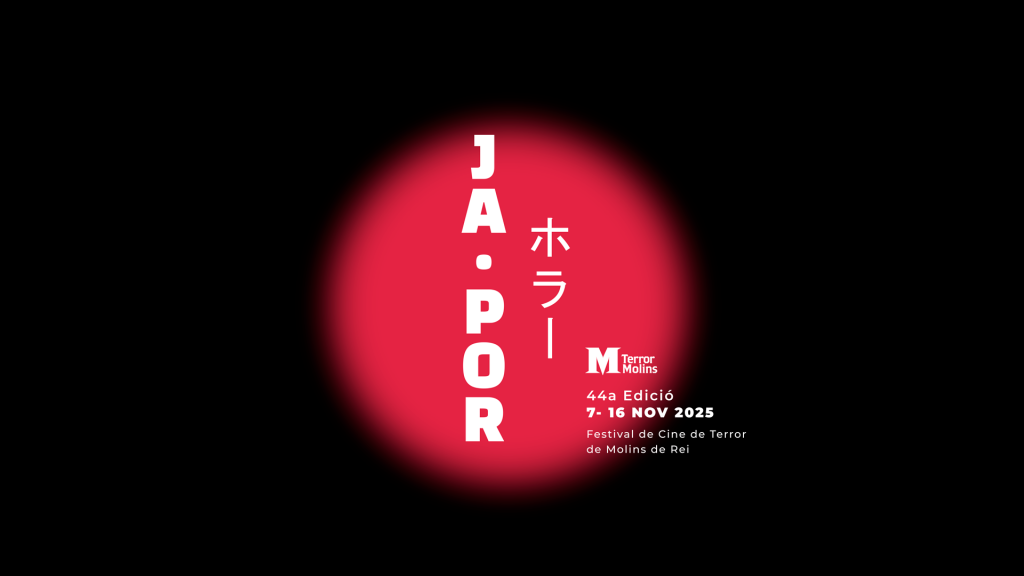
The leitmotif of the 44th Molins de Rei Horror Film Festival will be "J-Horror, beyond scares", and with it we will celebrate the legacy of Japanese horror, from November 7 to 16, 2025.
Molins de Rei, June 10, 2025 — In 2000, Japanese filmmaker Takashi Shimizu presented Ju-on, the first installment of an emblematic and prolific cinematic lineage. This year marks the 25th anniversary of its release and the Molins de Rei Horror Film Festival 2025 joins in the commemoration by dedicating this edition to J-Horror —Japanese horror—, which marked the beginning of the new millennium. In this genre, the Japanese folklore and the modern technology (videotapes, telephones and computers) joined hands. This cinema focused on atmosphere and psychological discomfort, with ghosts like the’onryō —female figures from the afterlife seeking revenge— have become very popular icons. Despite tight budgets, J-Horror still generates unease today, thanks to a refined aesthetic, its symbolism, its slow pace and its ability to speak to us about the absurdity of modern life through trauma, stories of loneliness and existential terror.
J-Horror, beyond the scare is the leitmotif that will accompany this 44th edition of the festival, which will take place from November 7 to 16, with the La Peni Theatre as its main headquarters.
We start the countdown to the start of I TerrorMolins 2025 with this text:
“In the nineties, the uninhibited slasher and a parodic touch of Chucky, Scream, I Still Know What You Did Last Summer reigned supreme… But the entry into the new millennium coincided with the boom of J-Horror, a breath of fresh air that revitalized the genre with films (and video games) where vengeful ghosts scared the staff. Ju-on and Ju-on 2 are from 2000 and were distributed directly to video, but their word-of-mouth success allowed Takashi Shimizu to shoot two years later, with more resources, Ju-on: The Grudge, more of a sequel than a remake.
The terrible story has its origins in a house in Tokyo, when Takeo Saeki, convinced that his wife is unfaithful to him, brutally murders her and does the same to his son Toshio (and the cat). In Ju-on we find the classic theme of a haunted house (the film's central character) and a vengeful ghost or onryō. Most onryō are women who had been abused in life by their parents, husbands or lovers and have an unmistakable appearance with roots in Kabuki theater: unkempt and very long black hair, ultra-pale makeup and a white kimono of mourning. According to popular belief, when someone dies a victim of anger, it generates a curse that settles in the places where they moved and where they died. If you enter one of these places or come into contact with someone cursed, you will become a victim and will spread it as if it were a virus.
Two years earlier, Sadako emerging from the television in Ringu (Hideo Nakata, 1998) had put J-Horror on the map, with the archetype of the ghost of the well and the symbolism of stagnant water associated with death, which we will also find in Dark Water (Hideo Nakata, 2002). Cult filmmakers such as the prolific Takashi Miike jumped on the bandwagon with Chakushi ari (Missed Call) in 2003, where he repeated the effective clichés of the subgenre, far from the dense and unclassifiable Ôdishon (Audition) with which he amazed us in 1999 (both of which we were able to enjoy at TerrorMolins).
In recent years, the fever for J-Horror seems to have subsided, after juicy crossovers like Sadako vs. Kayako (2016), which unabashedly mixes the mythologies of Ringu and Ju-on. But, for example, last year Kôji Shiraishi signed House of Sayuri, also with a haunted house, and in 2022 Kisaragi Station, by Jirô Nagae, about a cursed train station, was released. Hold on tight to your seat, the girl with the whitest face and endless black hair can appear when you least expect it!!”